
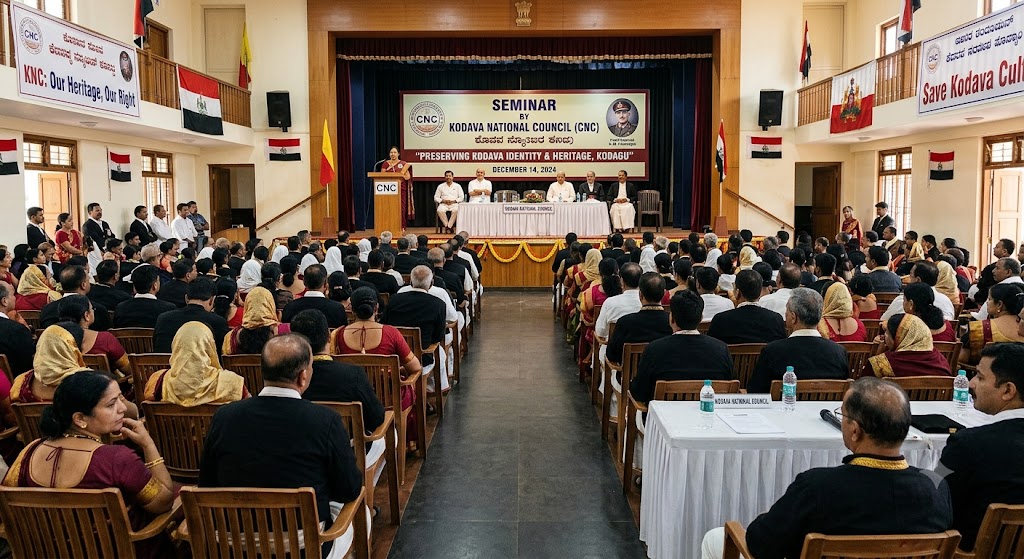

Madikeri, June 26: A seminar on “Special Status for Kodava, Constitutional Pathways and International Law” was organised at the Capital Village Resort on the outskirts of the city under the chairmanship of CNC President N.U Nachappa.
Speaking as the keynote speaker of the seminar, Supreme Court lawyer Vikram Hegde said that protecting the unique identity of Kodava is essential to maintain the pluralism of India. Kodava, which was earlier an independent ‘Part-C’ state with its own 24-member assembly, has been systematically merged into larger constituencies. At present, in the Mysore-Kodagu Lok Sabha constituency, Mysore voters outnumber Kodagu voters by a ratio of 3:1, which has made independent political representation institutionally impossible, he said. He said that it is reasonable for the Kodavas to demand a separate Lok Sabha seat during the delimitation of constituencies, and that it is necessary to provide appropriate documents to the Delimitation Commission for that. The terrain of the delicate, mountainous Western Ghats of Kodaga is different compared to the plains of Mysore. He said that a separate seat can be demanded on the basis of the uniqueness of the unique Jamma, Sagu and Bane land holdings.
Analyzing the cultural and religious significance of the Kodavas' traditional right to possess firearms without a license, Vikram said that the Karnataka High Court (in the case of Captain Chetan Y.K. and Union of India) has upheld the exemption under Section 41 of the Arms Act, 1959. This is possible due to the unique history and traditions of the Kodavas. But since government notifications are subject to change, this right should be permanently secured as an “essential religious practice” under Article 25 (Right to Freedom of Religion). There are three legal criteria to prove essential religious practice: Test of indivisibility: Proving that the Kodavas are incomplete without guns for birth, Kailpod, Puttari and death ceremonies, Historical evidence: Entrenching written and oral traditions such as Pattole Palame and historical British records, Public peace record: Demonstrating a century-long record of use of harm-free, peaceful practices, Vikram said, could make the right to gunpowder permanent.
Speaking on territorial autonomy, Vikram said that encroachment on sacred forests (Devarakads), uncontrolled tourism and threats to Jamma Bhumi were direct consequences of the Kodavas’ lack of political autonomy. The ultimate solution to this is to secure regional autonomy under the Sixth Schedule or Article 371 of the Indian Constitution, he explained in detail on the occasion.
Supreme Court and New York lawyer Hima Lawrence Vikram Hegde spoke on the topic “Kodaland Geo-political Autonomy, Self-Government and Local Kodava Ethnic Identity under International Law” and addressed international legal norms.
Explaining how a modern state should treat a small community with its own unique language, rituals, lineage and sacred places..? She said that since the community is unique, the Constitution should ensure that the voice of the community is protected. Kodava ainmanes, mands and festivals are not just private pastimes; they form the public identity of the community.
Kodagi is intertwined with land, Jamma holdings, sacred forests (Devarakad) and coffee landscapes. He made it clear that development cannot be measured only in terms of resorts and concrete, but rather in terms of environmental and cultural survival. He opined that the Kodava language will survive only when it goes beyond formal pride and enters education, digital preservation and public life.
Chief guest, jurist K.P. Balasubramanian spoke about the Kodava identity and opined that the Kodava are a very rare ethnic group and it is necessary to protect them under the Constitution.
Kodava National Council President N.U. Nachappa spoke and reiterated his resolve to achieve geo-political autonomy and self-governance for the primitive, mono-ethnic and nature-worshipping (animistic) Kodava people of Kodavaland. He said on this occasion that this struggle, which has been going on peacefully for the last 36 years, will continue until the Government of India and the Government of Karnataka provide constitutional protection to the Kodavas, a very small and delicate community.
The seminar was attended by Nandetira Kavita Subbaiah, Pullera Swathi Kalappa, Lieutenant Colonel B.M. Parvathi, Pattamada Lalitha Ganapathy, Apparanda Nandini Nanjappa, Ajnikanda Gana Machaya, Nandineravada Nisha Achaiah, Nandineravada Sumitra Dinesh, Achchakalera Alamanda Jai Ganapathy, Pattamada Kusa, Bacharaniyada Chippanna, Nandetira Ravi Subbaiah, Pullangad Natesh, Jammad Mohan, Mandapada Manoj Mandanna, Areyada Girish, Ajjikuttir Lokesh, Kiriyamada Sherin, Pullera Kalappa, Dr. Chaurira Jagat Thimmaiah, Retired IAS Officer Averamadanda Monnappa, Madikeri Kodava Samaj Director Nandineravada Dinesh, Kukkera Jaya Chinnappa, Cholapanda Nanaiah, Nandineravada Viju, Medura Kanthi Naniyappa, Nandineravada Ayyanna, Kottukattira Bobby Palangappa, Pudiokkada Kashi Karumbaiah, Bepadyanda Dinu, Bepadyanda Biddappa, Palekanda Pradhan Poonachcha, Acchakalera Naveen Monnappa, Kodava Saha
Disclaimer: This article has been translated by xklsv.com using advanced AI-based translation tools. Please note that the use of AI for translation is still experimental and may not be 100% accurate. The original content is sourced from shakthidaily.info, and Shakthi Daily is not responsible or liable for any errors, omissions, or inaccuracies that may appear in the translated version, including spelling, grammar, or contextual misunderstandings.
If you come across any mistakes or inconsistencies in this translation, we kindly request you to report them by sending an email to [email protected]
Your feedback will help us improve the quality.
The image in this article has been generated using artificial intelligence and is intended for illustrative purposes only. It may not reflect real-world accuracy.
.jfif)
**Awareness Is Key to Eradicating Corruption: Sadashiva Swamiji** ...
Read More
.jfif)
Virajpet Ganesha Immersion Festival Concludes in Grand Celebration ...
Read More