
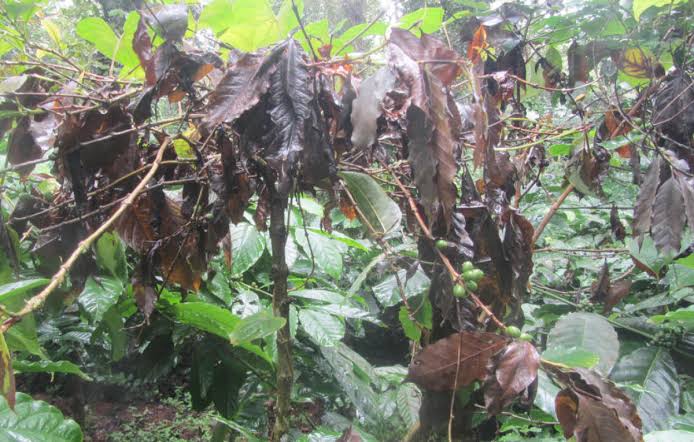

Chettalli, Aug. 9: This monsoon has become a season of anxiety for coffee growers. The continuous torrential rain has dashed the dreams of growers who were expecting a good yield. In Surlabbi, which ranks third among the areas with the highest rainfall in the state, the coffee crop has been affected by rot due to the excessive rain this time, and the Arabica and Robusta coffee crop is falling in large quantities. Since the leaves of the plants have also started falling, there is a fear that it will adversely affect not only this year's yield, but also the production of the next season.
135 inches of rain in Surlabbi
In the torrential rains that have been pouring in Surlabbi for the past month, 8 to 9 inches of rain were recorded in a single day, bringing the total rainfall this season to 135 inches. The heavy rains have caused waterlogging in the gardens, and the lack of sunlight has caused moisture to remain in the plants for a long time. As a result, rot disease has intensified and coffee beans are falling to the ground before they ripen. Since the leaves of the plants have also started falling, there is a fear that it will adversely affect not only this year's yield, but also the production of the next season.
Damage spread to many villages
A similar situation was observed in most of the coffee gardens in Surlabbi, Kumbaragadige, Kikkaralli, Mankya under Garwale Gram Panchayat of Somwarpet taluk and Hammiyala and Mutlu areas under Gaalibeedu Gram Panchayat of Madikeri taluk. In many gardens, coffee beans are seen falling from under the trees, and the sight of months of hard work turning into dust before our eyes has dismayed the growers. The growers, who were expecting good prices and good yields, are now facing a big challenge of saving their crops.
Coffee growers fear rot
Coffee crop has started to fall in some parts of the district due to rot. The rot is becoming a curse for growers, affecting the Arabica crop first and Robusta crop is also being affected by rot. Despite the Coffee Board announcing several control measures, growers say that the rot has not been controlled due to continuous rain.
Distress for small and middle class growers
This development is a harbinger of severe financial hardship for the families of small and middle class growers who rely on coffee as their livelihood. At a time when fertilizer, wages, medicines, plantation maintenance and labor costs have already increased, the crop failure is likely to further reduce their income. Many growers, who are burdened with loans from banks and cooperative societies, are facing the threat of further hardship due to the decline in this year's yield.
Joint RTC farmers' grievance
Despite suffering crop losses due to natural calamities, many coffee growers with joint RTCs have complained that they are not getting any assistance from the government and the Coffee Board, including crop loss compensation and subsidies. Many farmers are being deprived of relief schemes because the land records are in the names of several members of the same family. The farmers have demanded that the rules should be amended so that farmers with joint RTCs also get crop insurance, crop loss compensation and all government facilities. There is also a demand that a separate coffee crop compensation package be announced for areas hit by heavy rainfall like Kodagu.
Urgent survey demanded
In the wake of widespread rot due to incessant rains, the farmers have demanded that the Coffee Board, Horticulture Department, Agriculture Department and Revenue Department officials should immediately visit the affected areas and conduct a comprehensive survey of crop damage. Since the coffee bean turns black within three to four days of falling, it will not be possible to estimate the actual extent of the damage if the inspection is delayed. Therefore, the growers have demanded that the authorities immediately visit the spot and record the crop loss and provide technical advice and necessary drug treatment for controlling the blight.
Growers' cry
After serving the country, I have been dependent on coffee farming for the last ten years. But due to the excessive rains in July-August every year, Arabica and Robusta coffee are falling due to blight and falling before the fruit is even ripe. An even bigger problem is that due to the existence of a joint RTC, not even a single rupee of compensation is being received from the government or the Coffee Board. On one hand, nature is taking its toll, on the other hand, the system itself has given up. The authorities should visit the spot and record the actual damage, not after the heat, but when the coffee is falling. Gappu Somayya, a coffee grower and former soldier from Surlabbi village, has demanded that the government take action so that farmers with joint RTCs also get compensation for crop loss.
Demand for special package
Surlabbi Nadi, which is ranked third among the areas with the highest rainfall in the state, has been cursed by heavy rainfall this time. Due to the heavy rainfall year after year, rot disease and coffee crop failure are increasing, and growers are suffering huge losses. The government should identify this area as a special heavy rainfall coffee zone and announce a special relief package. Chamera Dinesh, a grower from Mankya village, has demanded that the Coffee Board and the Horticulture Department conduct a special study to find a permanent solution.
Disclaimer: This article has been translated by xklsv.com using advanced AI-based translation tools. Please note that the use of AI for translation is still experimental and may not be 100% accurate. The original content is sourced from shakthidaily.info, and Shakthi Daily is not responsible or liable for any errors, omissions, or inaccuracies that may appear in the translated version, including spelling, grammar, or contextual misunderstandings.
If you come across any mistakes or inconsistencies in this translation, we kindly request you to report them by sending an email to [email protected]
Your feedback will help us improve the quality.
The image in this article has been generated using artificial intelligence and is intended for illustrative purposes only. It may not reflect real-world accuracy.

K.S. Bharat Kumar Appointed Additional Judge of High Court ...
Read More
.jfif)
Arun Machayya Earns International Recognition...
Read More