

Bengaluru, June 5: Both Arabica and Robusta, the two major coffee varieties that dominate global coffee production, are facing stress due to rising temperatures and changes in rainfall patterns.
Temperatures above 30 degrees Celsius reduce yields. They affect the quality of the coffee and increase stress on the plants. Arabica coffee, in particular, is more heat-sensitive than Robusta. India grows both varieties, mainly Robusta, mostly in the Western Ghats.
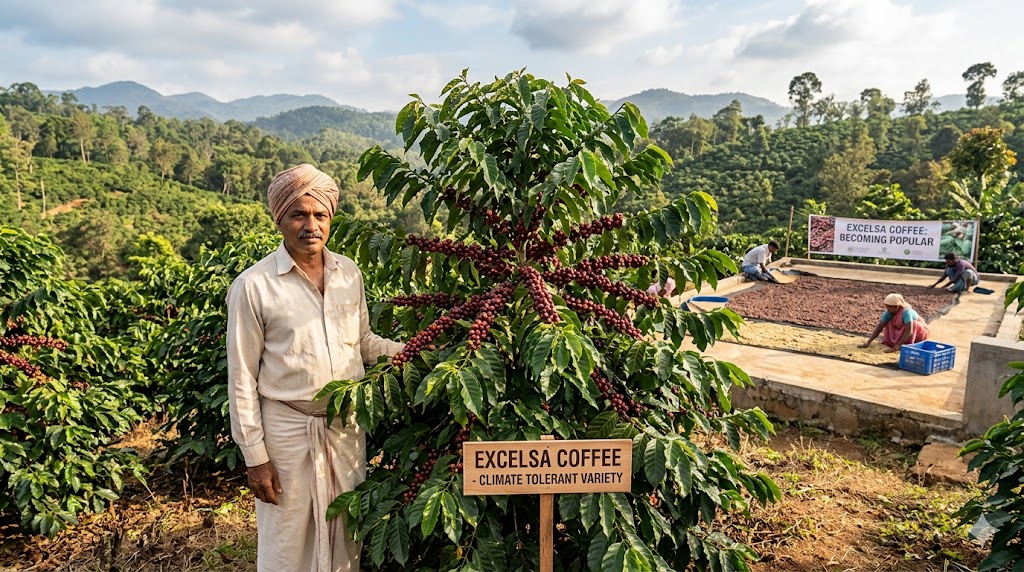
With changing climatic conditions around the world, researchers and growers are turning to alternative and more drought-tolerant coffees. Excelsa is a prominent variety among them. Excelsa, which is widely grown in tropical and parts of West Africa and Southeast Asia, is not new to India. This type of coffee is grown for shade or even along fences. But it is rarely grown as a main crop.
In the late 1800s, British planter Colonel Benson introduced Excelsa to India as an alternative to Arabica, as it was pest and disease resistant. However, the plant grew to a height of six to 15 metres and was densely branched, making it impractical for full-scale plantation management.
Akshay Dasharath, co-founder of the South India Coffee Company, has around 60-year-old Excelsa coffee plants on his coffee estate in Nakoor, near Suntikoppa. His grandfather used to drink only Excelsa at home. “It was mixed with Arabica in Kerala,” he recalls.
The Coffee Board of India had advised cutting down Excelsa, Dasharath said, as it was susceptible to pests such as the berry borer. However, Dasharath’s family refused and decided to preserve the plants. Today, the same plants are gaining new interest. In 2025, South India Coffee Company sold more than four tonnes of Excelsa coffee and in 2026, it is estimated that this will increase to five tonnes.
The Kerehaklu Estate in Chikkamagaluru district has been growing Excelsa and Liberica coffee varieties since 1953. “We are seeing weather-related problems, especially long and intense rains in the early summer,” said Pranay Thippaiah, the estate’s managing partner. Excelsa and Liberica are more suited to climate change, he said. They are harvested in March and April. Globally, coffee researchers have identified 133 different varieties of coffee. While many are not yet commercially available, they are now being studied for their ability to withstand changing climates.
Excelsa is a coffee variety with the ability to withstand extremes. It is already being grown on a large scale in Uganda and Vietnam and could soon enter mainstream supermarkets. “Ugandan Excelsa could be in supermarkets within a decade,” experts say. Ugandan farmers have been growing hundreds of acres of Excelsa since the early 2000s. Kivuka Catherine, a senior research officer at the Uganda National Agricultural Research Institute, said that smallholders and large farmers in Uganda are increasingly growing Excelsa as it adapts to climate change.
In addition, the coffee variety Stenophylla is more heat-tolerant than Arabica and more drought-tolerant than Robusta, and has a flavor that is almost identical to Arabica.
The hybrids have been shown to have better resistance to heat and excess moisture stress, as well as disease resistance. These improved hybrids can be brought into production quickly. The researchers have proposed a new name for this interspecific hybrid, Coffea x Libex (commonly known as Libex coffee).
The future of coffee growing and consumption could see varieties such as Excelsa, Stenophylla or Liberica come to the fore. “The mild aroma and low caffeine content of Excelsa or its use in instant coffee are pleasing to consumers,” experts say.
Disclaimer: This article has been translated by xklsv.com using advanced AI-based translation tools. Please note that the use of AI for translation is still experimental and may not be 100% accurate. The original content is sourced from shakthidaily.info, and Shakthi Daily is not responsible or liable for any errors, omissions, or inaccuracies that may appear in the translated version, including spelling, grammar, or contextual misunderstandings.
If you come across any mistakes or inconsistencies in this translation, we kindly request you to report them by sending an email to [email protected]
Your feedback will help us improve the quality.
The image in this article has been generated using artificial intelligence and is intended for illustrative purposes only. It may not reflect real-world accuracy.


Concerns Mount Over Power Outages in District...
Read More.jfif)
Government Mulls ‘Land Guarantee’ Scheme: Ponnanna ...
Read More
Mosaru Kudike' and Fancy Dress Competitions Draw Attention...
Read More