

Madikeri, Aug. 10: Indian coffee has its own mark on the global stage. Especially, the coffee produced in the Kodagu district of Karnataka is famous for its taste and aroma. Not only in Karnataka, Kodagu district ranks first in coffee production in the country.
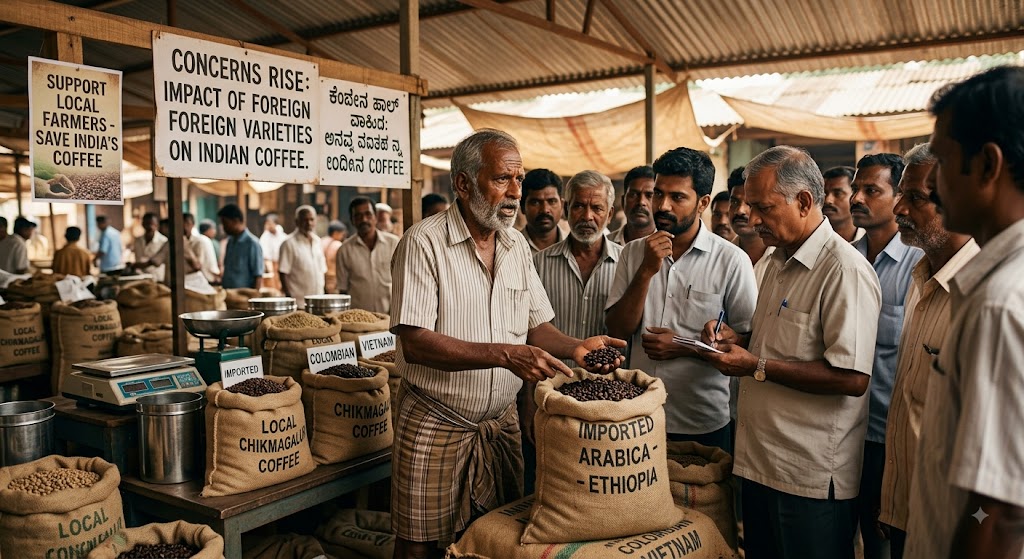
Everyone is aware that coffee is the backbone of the entire district's economy. In the current days, despite dozens of problems, natural disasters, and uncertainties, coffee cultivation has its own importance in India. But now, it is a worrying issue that there is an attempt to grow foreign coffee varieties along with the coffee varieties produced in the country. Some confusion has been created about the idea of introducing foreign coffee varieties in India without any scientific solidity. It is said that introducing foreign varieties in this way without trust is likely to be very harmful to the country's coffee industry in the future.
What is a foreign variety?
The Coffee Board has now come to the notice of the private introduction and cultivation of foreign coffee varieties. There are instances of some private individuals/nurseries selling Vietnamese-origin coffee varieties like KhiSS, KhiKh9, KhiKh11 and Brazilian-origin coffee varieties. The Coffee Board itself has warned that advertisements are being widely circulated on social media about these.
The Coffee Board does not have any official information about the scientific reliability and performance of these varieties. The Coffee Board has now expressed the risk of introducing any foreign plant planting material into India without proper import permits and plant quarantine rules, which may lead to the entry of pests, diseases and harmful weeds that are not present in India. A statement by Dr. M. Senthilkumar, Director of Research, Coffee Board, in this regard has now gained importance.
In fact, it is mandatory to import any plant planting material as per the standards set by the Government of India. This will ensure that the necessary quarantine rules are followed and no pests, diseases or harmful weeds enter the plantation ecosystem.
Till now, the Coffee Board has not given official recognition or approval to any private nursery or private plantation for importing foreign coffee varieties from any coffee producing country. Therefore, purchasing coffee seedlings from unauthorized sources is likely to be detrimental to the entire coffee industry in the country. Also, the Coffee Board has not verified and confirmed the performance of such varieties in Indian conditions.
The Central Coffee Research Institute is conducting extensive research related to the development of coffee varieties and recommends any new variety to the farmers only after successful completion of multi-local trials in various regions. The objective is to promote sustainable and economically viable coffee cultivation in the country and to ensure that farmers grow only scientifically validated varieties/clones/hybrids.
Keeping this in mind, all associations, growers and stakeholders are advised to be wary of such attractive advertisements and to take any decision only after verifying the veracity of such information with the scientists of the Coffee Board, Senthil Kumar mentioned.
Supply from Shivamogga
As far as ‘Shakti’ has come to know, such varieties are being supplied by a nursery in Shivamogga. Many people from Kodagu district have gone to Shivamogga and brought the plants. Rs. 130 per plant, along with other expenses, the cost is Rs. 200.
Violation of rules
There are several provisions for introducing such varieties of foreign plants to India. But it is said that those who have set up nurseries here have not followed any rules. When the plants are brought, they should be kept in quarantine for 40 to 90 days. In addition, it should be confirmed that it is suitable for the country with its scientific verification. But it is a serious matter that all this is not being followed here.
Notice to those concerned
Shakti has also learned that a notice has been issued through the Coffee Board regarding the sale of foreign varieties of plants and an explanation has been sought. Details of where it was brought from and how it came to India have been requested, and this has also been investigated.
Reasons for the discussion
It is natural for growers to start growing foreign varieties of plants with the hope of a new effort and a better harvest. But there are some points that are being discussed here.
What is the reality of this variety abroad, is it compatible with the climate there and the climate and soil of India, are there diseases and pests in this variety there, will it be fatal to the country in the future, etc. Discussions have now begun among coffee growers.
As far as 'Shakti' has learned, a prominent grower from Sakleshpur wrote a letter to the Coffee Board and drew its attention to the matter, which is now being reviewed by the Coffee Board's research department.
Disclaimer: This article has been translated by xklsv.com using advanced AI-based translation tools. Please note that the use of AI for translation is still experimental and may not be 100% accurate. The original content is sourced from shakthidaily.info, and Shakthi Daily is not responsible or liable for any errors, omissions, or inaccuracies that may appear in the translated version, including spelling, grammar, or contextual misunderstandings.
If you come across any mistakes or inconsistencies in this translation, we kindly request you to report them by sending an email to [email protected]
Your feedback will help us improve the quality.
The image in this article has been generated using artificial intelligence and is intended for illustrative purposes only. It may not reflect real-world accuracy.
Karnataka Maratha Communities Development Corporation Invites Applications ...
Read More

**Virajpet Ganapathi Immersion Festival Held ...
Read More.jfif)
Diya Earns Selection for World Junior Badminton...
Read More