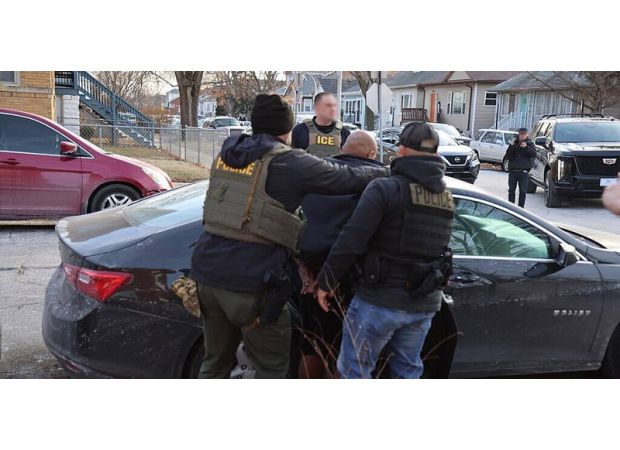
Last week, tragedy struck in Minneapolis, Minnesota when 37-year-old Renee Good was fatally shot during an ICE operation. This devastating event sparked outrage across the country and reignited protests in the city. As federal law enforcement activity continues to intensify, the nation's attention has once again turned to a place many associate with the modern civil rights movement.
In light of these events, BLACK ENTERPRISE had the opportunity to speak with Georgia Fort, an independent journalist and native of Minnesota. With her own radio station, Power 104.7 FM, and a non-profit organization, the Center for Broadcast Journalism, Fort is dedicated to training journalists and building local media infrastructure.
Having been on the ground in Minneapolis since the shooting, Fort expressed a sense of sad familiarity with the current state of events. She shared, "To be here in Minnesota and knowing what we experienced back in 2020, it just feels like it happened here twice. There was already protesting happening before Renee Good was fatally shot, but her tragic death caused the nation to erupt in protest. Going back to 2020, it feels like we were the epicenter of this global movement. And now, it feels like we're here again. However, this time it's different. It's not just local law enforcement, but the federal government involved."
As a St. Paul native, Fort has spent years reporting on police accountability, civil unrest, and government response in the Twin Cities. She emphasized that Minneapolis did not become a flashpoint overnight, stating, "The world came to know about the struggles here through George Floyd. But George Floyd didn't happen in a vacuum. There was the 18-day occupation in the middle of winter for Jamar Clark. There was Philando Castile. The world saw it, but it didn't erupt nationally. It was still just our fight."
She continued, "When you talk about Minnesota being ground zero, it's important to acknowledge that there has been a continuation of injustices that have shaped organizations and leaders here. They have learned how to stand up, organize, and use civil disobedience to push elected officials to make decisions that help protect our civil and constitutional rights."
Fort recalled a recent conversation with a longtime organizer that shifted her perspective on this moment. "I said, 'We're ground zero again,' and she responded, 'What do you mean again? We never stopped being ground zero.'"
Being present at the scene shortly after Renee Good's death and documenting the aftermath highlighted the complexity of the situation. Fort noted that while national coverage has focused on the shooting itself, it has largely missed what was happening simultaneously across the city. She explained, "There are daily protests happening in multiple locations at the same time. There are rapid response groups reporting arrests every minute. And on top of that, the infrastructure of these groups was targeted with a cyberattack. The publisher of the major newspaper was also attacked. These things are happening while people are in the streets, and I don't think the national media fully understands the full extent of what people are experiencing."
She also pointed to earlier ICE activity in Minnesota as crucial context that is often overlooked. "In June, the first big ICE raid happened here, and there was a huge protest," she shared. "Days later, one of the protesters did an interview with us. She was arrested at my office."
Fort revealed that the woman, a Latina protester and legal U.S. citizen, was charged in ways that seemed designed to discourage dissent. "They've delayed her trial four times. To me, that felt like intimidation. We've seen similar charges brought against protesters across the country, and a high percentage of them don't hold up in court."
For Fort, the killing of Renee Good in Minneapolis raises questions that extend beyond one incident. She expressed, "The worst thing that could happen during an ICE arrest happened, and I don't know if our elected officials truly know what they can do to prevent it from happening again."
She added, "One of the questions I keep asking myself is, what power do municipalities, counties, and states have to leverage against constitutional violations of their residents? This nuance isn't reflected in a significant way."
Fort believes that this disconnect between rhetoric and action is something that independent journalists are uniquely positioned to explore. She stated, "National media helicopters in and then they leave. They don't have the context, the depth, or the relationships. Independent journalists usually have the trust of the community and can provide a more raw perspective."
She also noted that corporate outlets often rely on institutional sources, stating, "They're sourcing officials who have their own political agenda. They don't want to jeopardize those relationships."
Fort emphasized that unlike corporate outlets, independent journalists remain on the ground even after the cameras have moved on. She said, "The mayor says, 'Get the F out,' and it goes viral. But then what is the policy action? What's the follow-up? Independent journalists are still here asking, 'So now what?'"
Being present on the ground also allows for the discovery of contradictions that rarely make national headlines. Fort shared, "I was there at the crime scene after Renee Good was fatally shot. I saw the Minneapolis Police Department and Hennepin County Sheriffs extend the crime scene so that federal agents could exit safely. Yet, this wasn't reported anywhere."
Complicating coverage further is the rise of misinformation, particularly AI-generated content. Fort warned, "AI-generated images and videos are extremely dangerous for the spread of misinformation. Now, people say, 'Look at this picture, watch this video,' and it distorts reality."
She noted that older audiences are especially vulnerable, stating, "They don't have the cues to identify what's real and what's AI. These tools are being weaponized to justify violations of constitutional and civil rights."
According to Fort, due to the lack of in-depth coverage, it is crucial to support independent Black-led media. She shared, "People can help by taking the time to educate themselves. Public schools don't teach media literacy. Support doesn't have to be financial. It can be reading, listening, watching, and sharing the content produced by these companies. And yes, there is also the option of financial support. Whether it's a monthly subscription, a one-time contribution, or advertising and sponsoring events, these are all ways to support independent media and amplify their voices. Only then can we truly understand the full extent of what's happening in our communities."